
Church Quinquennial
Drone Surveys
High-resolution drone roof surveys, internal scanning and web-viewable 3D digital twins — supplied as structured evidence for inspecting architects, surveyors, PCCs and dioceses.
Faster, safer evidence for quinquennial inspections
Church of England churches require a quinquennial inspection every five years. We work alongside your appointed inspecting architect/surveyor to capture the high-quality survey evidence that’s often difficult, time-consuming or expensive to obtain from the ground.
Our role is to provide clear, repeatable visual and 3D documentation of the church fabric — helping you reduce working-at-height, minimise disruption, and improve coverage of roofs, towers, rainwater goods and high masonry.
What we capture for QI surveys
External envelope (drone close visual inspection)
High-resolution coverage of roofs, valleys, hips, ridges, parapets, gutters, downpipes, towers/spires, buttresses, tracery, masonry and leadwork — with imagery captured specifically for condition review.
Roof survey outputs that are easy to use
We deliver structured visuals that make it simple to locate issues and reference them in reports, including labelled imagery and “whole-roof” context views.
Internal spaces (where required)
For naves, chancels, aisles, galleries and complex interiors, we can capture internal geometry and visuals using ground-based scanning/visualisation methods when it supports the brief.
3D modelling and digital twins for QI
For churches with complex roof geometry, towers/spires or detailed stonework, a 3D model can be the most practical way to provide a single “source of truth”.
QI-ready 3D deliverables can include:
- Web-viewable 3D models for remote review and stakeholder discussion
- Photogrammetry meshes and textured models for fabric condition review
- Point clouds to support further technical work
- Scaled orthographic elevations (where appropriate)
- 3D visualisations that help your team understand hard-to-reach areas clearly
This is especially useful when multiple parties (architect, PCC, diocese, contractors) need to see the same evidence without repeated visits.
Access, safety and minimal disruption
Our workflow is designed to reduce reliance on scaffolding and MEWPs while improving coverage. We operate with site-specific RAMS and plan flights to minimise risk to the public and disruption to church activities.
Note: The quinquennial inspection itself must be undertaken by the suitably qualified professional under the diocese’s scheme. We support that process by supplying structured survey evidence.
Scaled Building Elevations
Our drone-based measured elevations provide an ideal companion to your Quinquennial Inspection (QI) work, delivering high-resolution, true-scale orthographic images of each façade without days spent on site.
By capturing the full external envelope quickly and safely from the air, we give you accurate, up-to-date elevation data that can be dropped straight into your CAD workflow and referenced throughout your QI report.
This approach not only reduces the need for total station work and repeat visits, it also gives you a clear visual record of defects, materials and detailing, helping you evidence findings, plan remedial works and track changes over time.
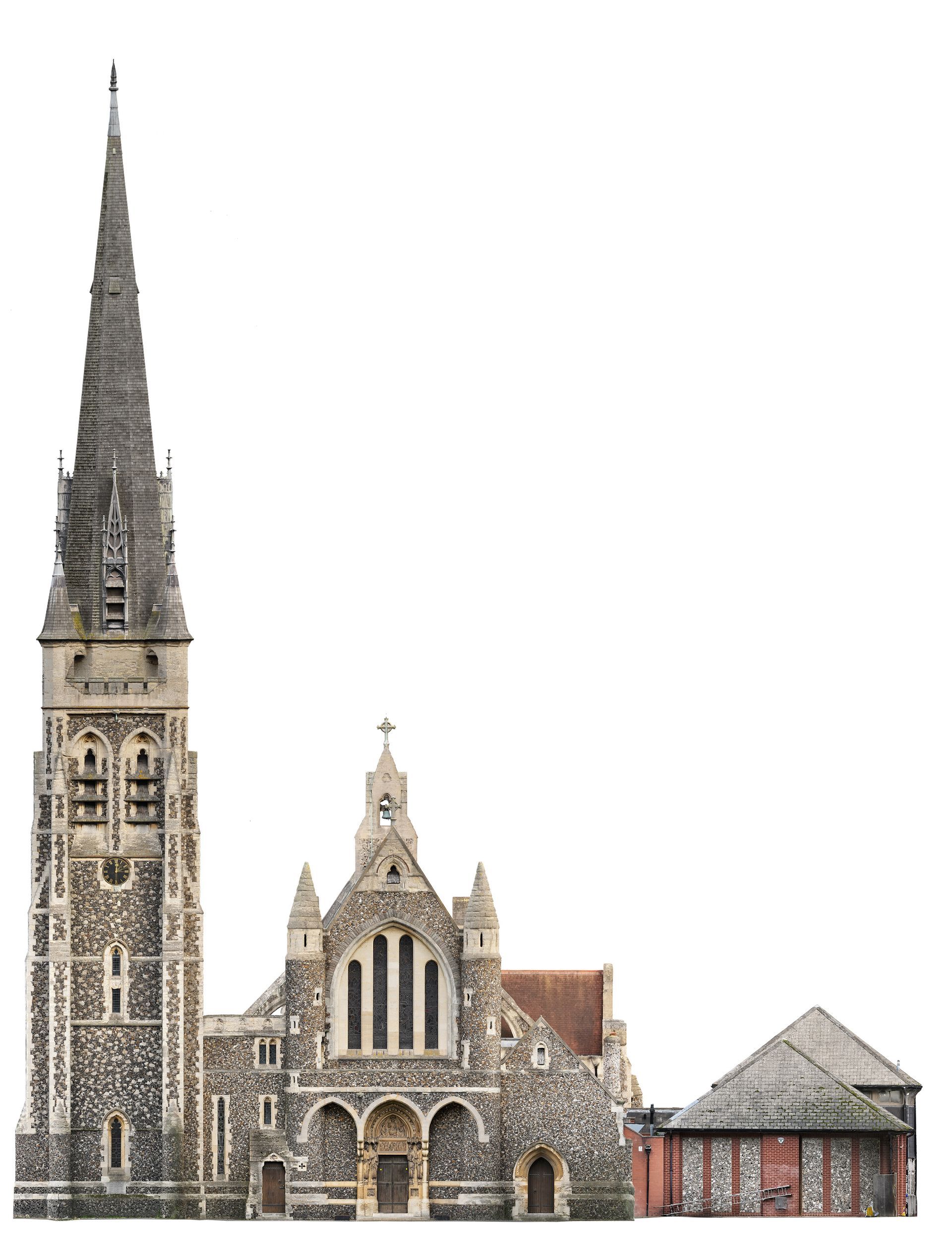
St Peter and St Paul's Church - Dry Drayton - Cambridgeshire
St Peter and St Paul's Church in Dry Drayton, Cambridgeshire, is a historic parish church with origins dating back to the 13th century. Built in the Gothic style, the church features a medieval tower, a nave with 14th-century arcades, and later Perpendicular-style windows. The church underwent restorations in the 19th century, preserving its historic character while adapting to modern needs.
Inside, notable features include a 15th-century font, remnants of medieval wall paintings, and several memorials to local families. The churchyard contains historic gravestones, adding to its heritage significance.

All Saints Church - Covington - Huntingdon
All Saints’ Church in Huntingdon, Cambridgeshire, has a rich history dating back to the medieval period. The current building primarily dates from the 15th century, though earlier churches may have stood on the site. Built in the Perpendicular Gothic style, it features a striking west tower, large clerestory windows, and elegant stonework.
The church underwent significant restorations in the 19th century, preserving its historic features while accommodating modern congregational needs. Inside, it houses notable memorials, including tributes to prominent local figures, and a finely crafted font.
Church Quinquennial Survey FAQ
What is a Church Quinquennial Survey (Quinquennial Inspection, QI)?
A quinquennial inspection is a five-yearly condition survey of a church’s fabric. It’s carried out by a suitably qualified inspecting architect/surveyor under your diocese’s scheme.
We support the process by supplying structured survey data (drone imagery, orthomosaics, point clouds, 3D models) that the inspecting architect can incorporate into the QI report.
Do you carry out the QI itself?
No—we support the appointed QI professional and PCC with high-quality survey evidence. Your inspecting architect/surveyor remains responsible for the statutory inspection and the report’s findings.
How does your work help with a quinquennial inspection?
We provide comprehensive external (roofs, towers/spires, parapets, rainwater goods, masonry) and internal (naves, chancels, aisles, galleries, voids) coverage with geo-referenced imagery, orthomosaics, point clouds, and 3D models. We can tag defects and priority-grade issues to map cleanly into the QI report (e.g., urgent / 12 months / 5-year plan).
Do you need scaffolding or cherry pickers?
No. Drones and internal SLAM scanning significantly reduce the need for expensive and disruptive access equipment. Where temporary access is essential (e.g., below a delicate ceiling), we’ll advise.
Is drone flying over churchyards safe and legal?
Yes—operations are conducted by qualified pilots under our CAA permissions and insurance, with a site-specific risk assessment and method statement (RAMS). We plan flight paths to avoid congregation/public areas and schedule around services and events.
What permissions do you handle?
- Landowner permission (PCC/diocese/churchwarden)
- Airspace checks/NOTAMs and local constraints
- Heritage sensitivities coordination (as needed with your architect, DAC, or local authority)
We liaise with your team to make the process straightforward.
How long does a survey take?
Smaller churches are often completed in half a day to one day on site; larger or complex sites may require 1–2 days. Processing/QA follows promptly and we deliver in staged milestones if helpful.
How much does it cost?
Fees depend on size, access complexity, deliverables and whether you need QI-ready annotation. We’ll scope a fixed price once we review basic details (location, photos, tower/spire, desired outputs).
What area do you cover?
We’re based in Cambridge and operate across the UK. Travel and scheduling are planned to minimise disruption and cost.
Do you work on non-church heritage sites?
Absolutely—abbeys, halls, listed houses, bridges, monuments and archaeological sites. The same methods apply, with deliverables tailored to conservation teams.